
PPF and vinyl wrap are different products solving different problems. Wrap changes the colour and finish of your car. PPF preserves the colour and finish your car already has. If you're between the two, that distinction is usually the deciding factor, and a lot of customers end up doing both (PPF on the front impact zones, wrap on the rest if they want a colour change).
Coverage tiers
You don't need to PPF a whole vehicle to get meaningful protection. Most stone-chip damage happens on a predictable set of panels, and coverage scales accordingly.
Every price below is a package price crossed with the film you pick. These are the same four packages and three films you'll see in the quote tool, at the same numbers.
| Package | What it covers | Ultimate | Platinum | Satin-Matte |
|---|---|---|---|---|
| Essentials | Leading 18″ of hood, front fenders, mirrors | $350 | $500 | $600–$825 |
| Standard | Leading 24″ of hood, front fenders, mirrors, front bumper, headlights | $925 | $1,050 | $1,175 |
| Full Front | Full hood, full fenders, mirrors, bumper, headlights, fog lights, A-pillars, roof line | $1,650 | $1,800 | $1,950 |
| Full Wrap | Every painted panel: front to rear, doors, roof, quarter panels, trunk, rear bumper | from $5,800 | from $6,500 | from $7,100 |
The three partial packages are flat prices; they don't change with the vehicle. Full Wrap does, because film consumption does: $5,800 covers a compact in Ultimate, and a full-size SUV in Satin-Matte is $9,350. Your vehicle lands somewhere in between, and the estimator will tell you where.
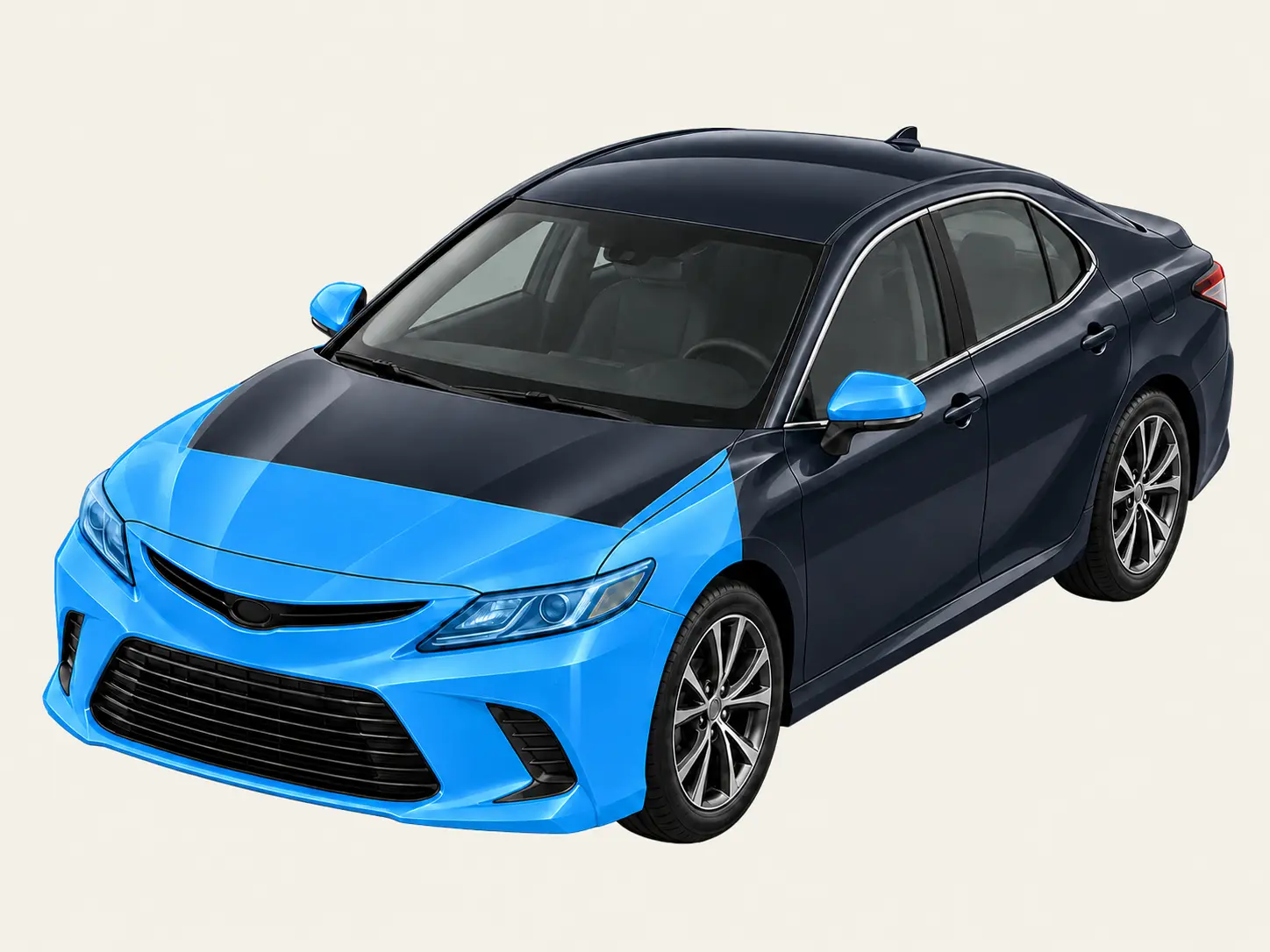
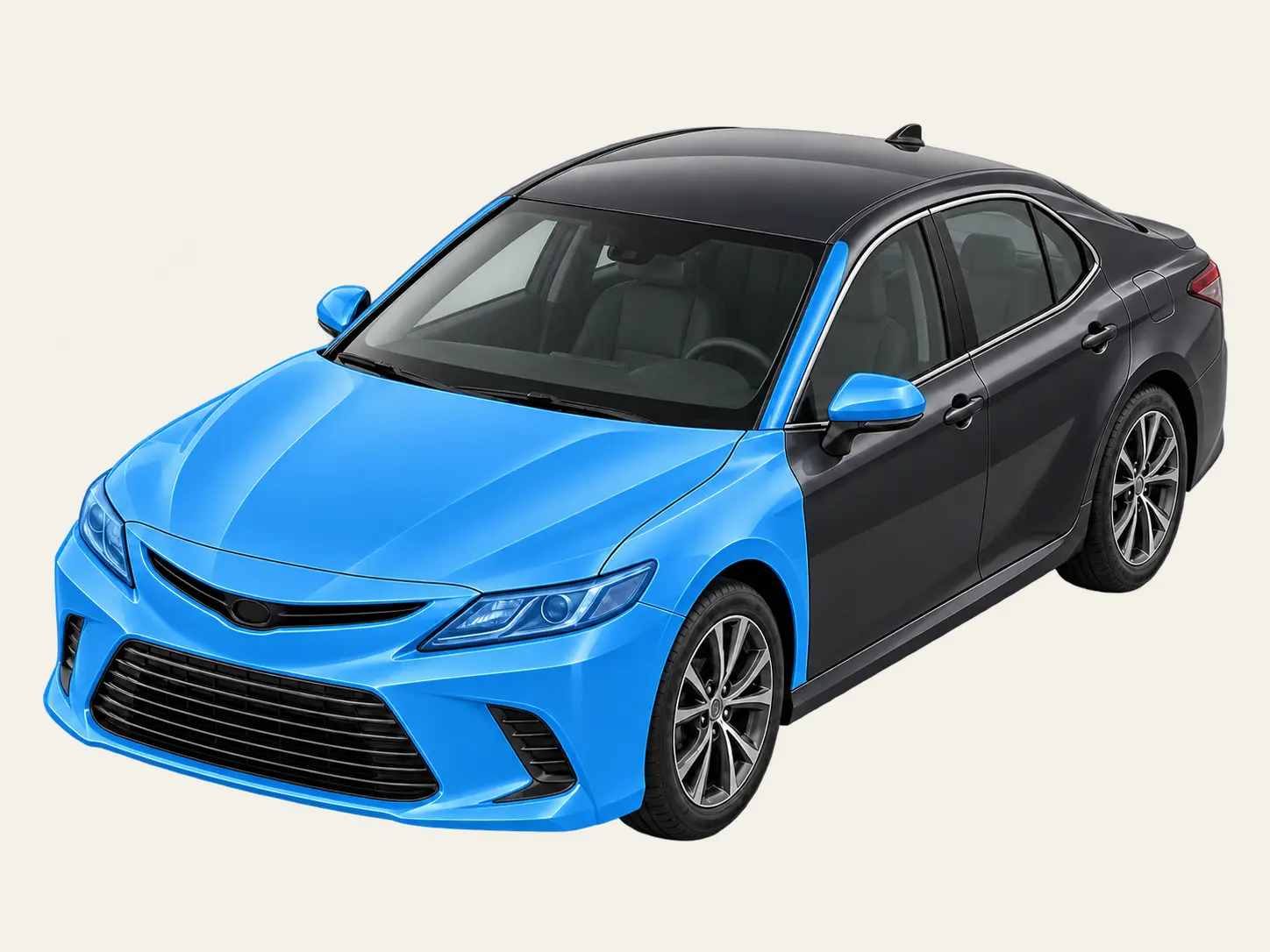
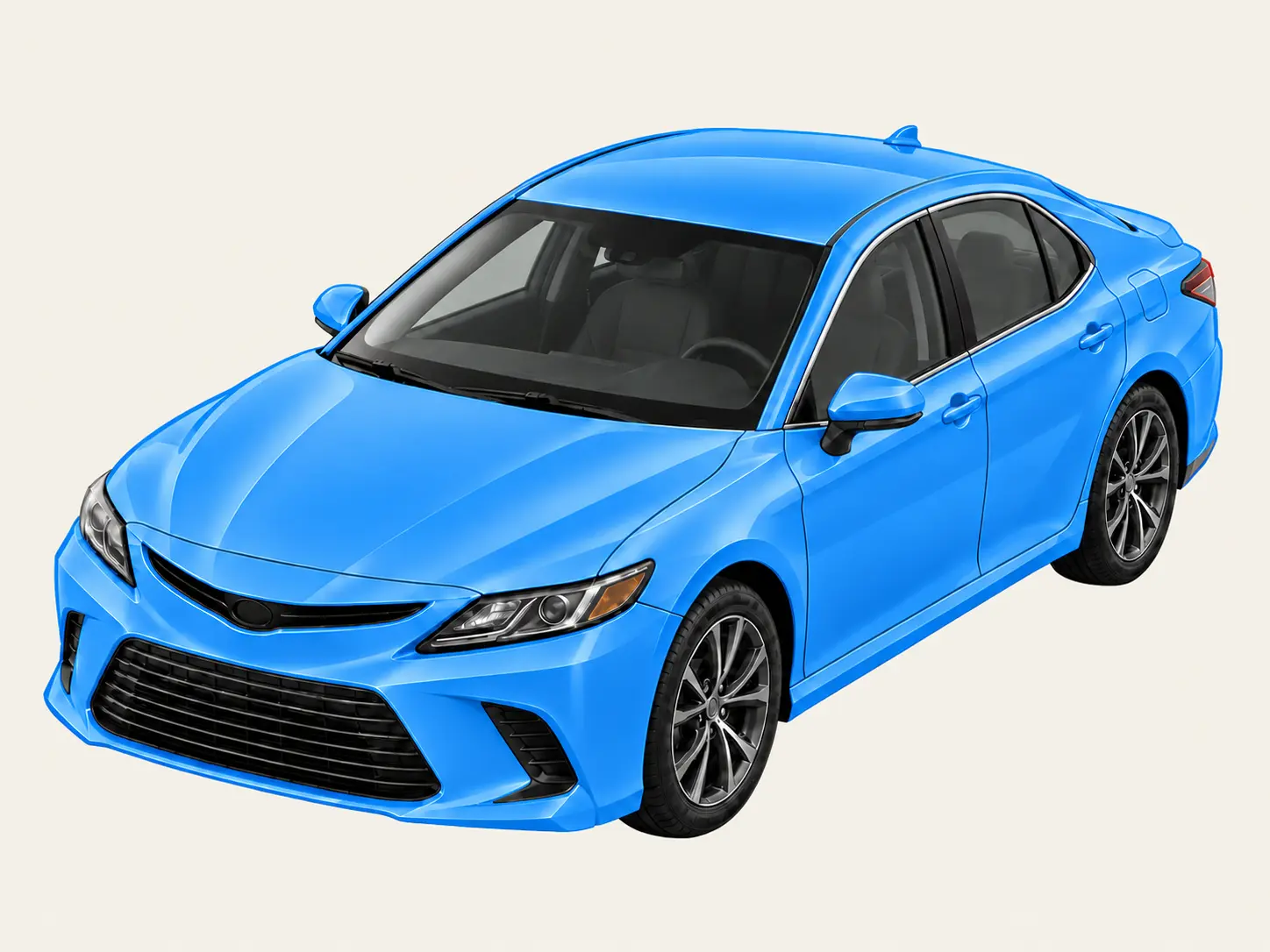
Standard is the one most Edmonton drivers should buy. The extra 6″ of hood over Essentials, plus the bumper and headlights, is where the highway stone-chip damage actually lands, and it costs a fraction of a Full Wrap. Essentials is the entry point when the budget is tight or the vehicle is a short-term lease. Full Front is the upgrade if you commute on QEII / Hwy 14 / Hwy 16 regularly, or if you want the fog lights, A-pillars, and roof line covered too. Full Wrap is mostly luxury, exotic, and concours-condition collector cars.
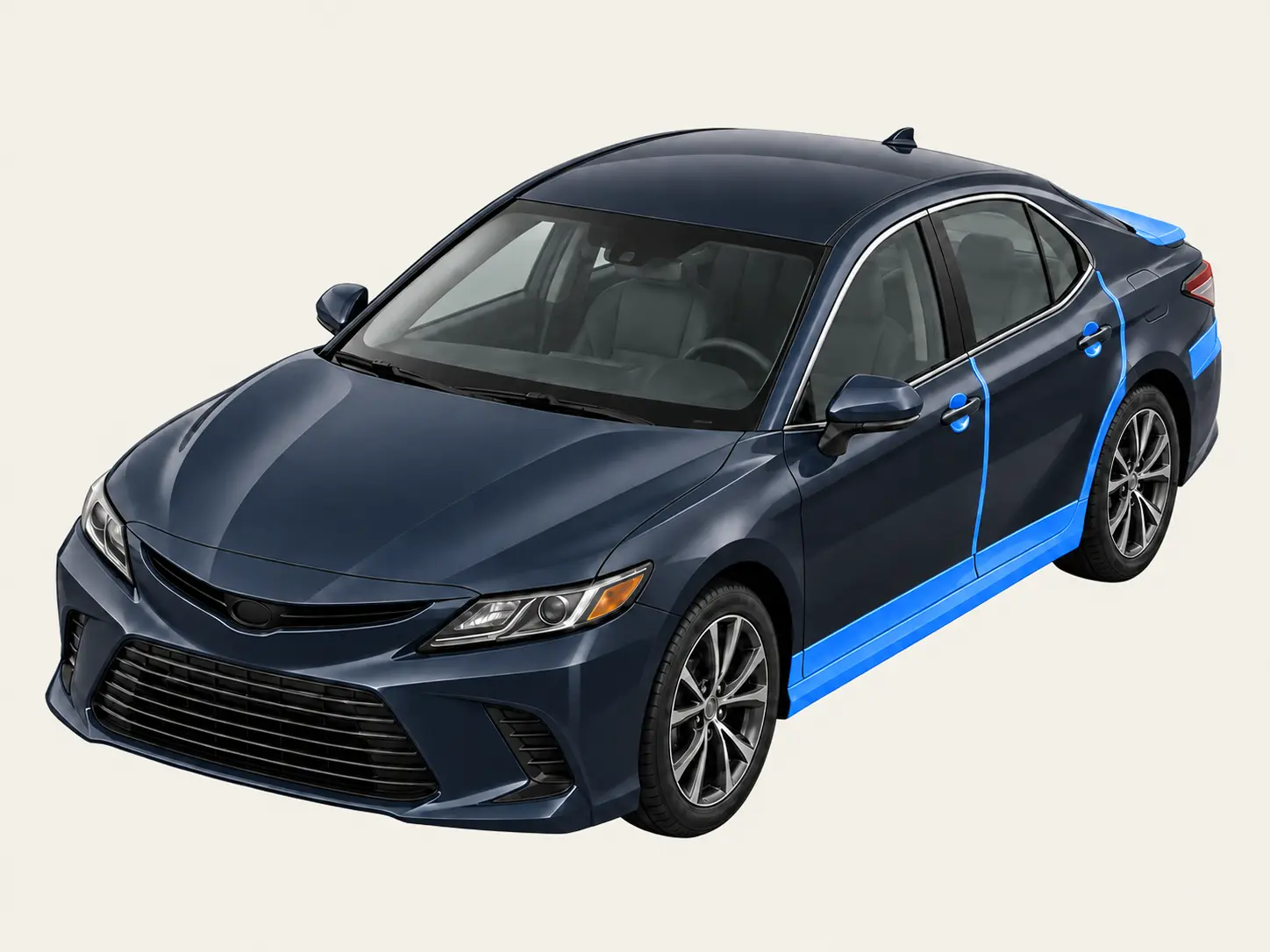
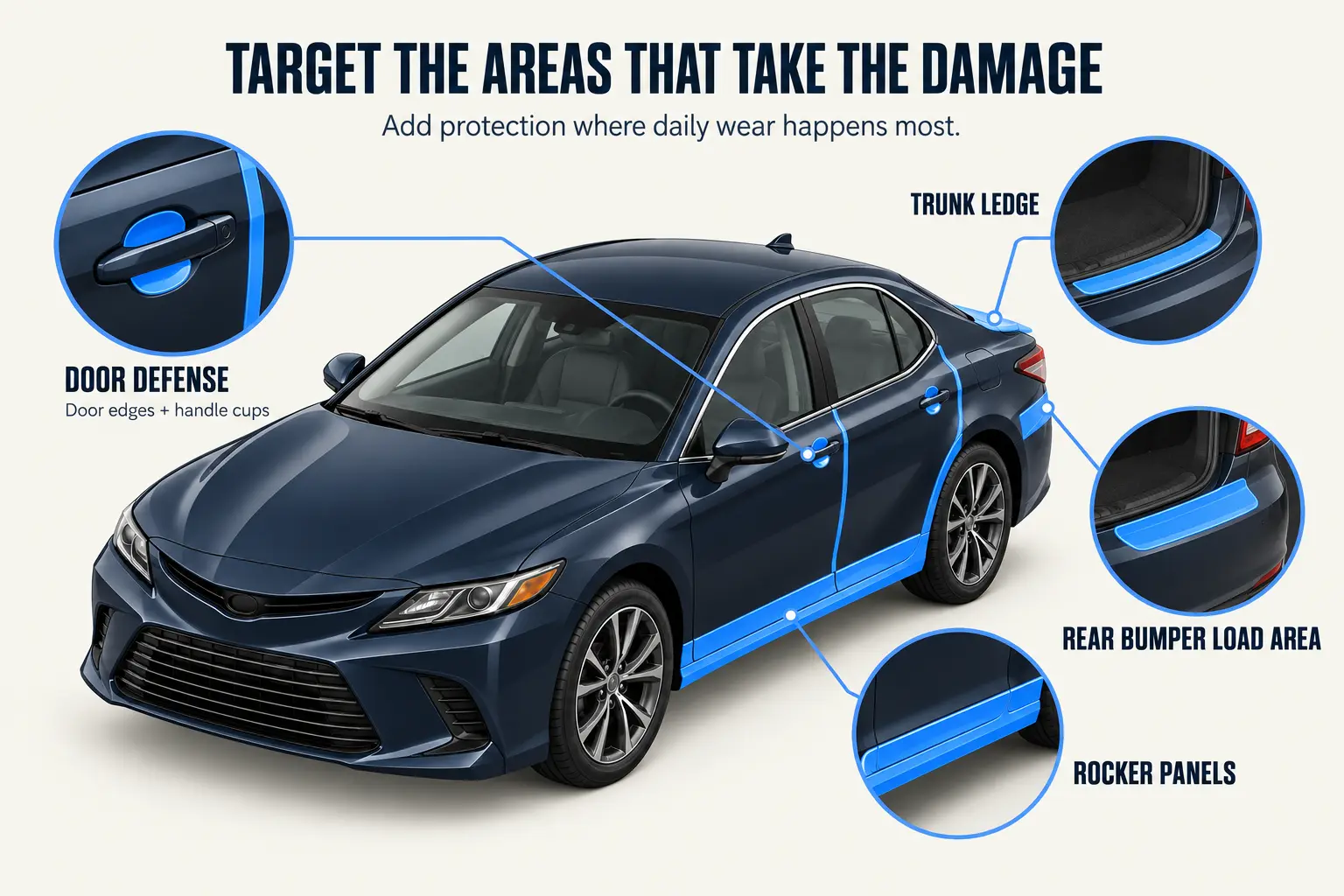
Every package is also available as individual panels, priced per area, and they can be added at any time. Many customers start with a front package and add door cups later when the first scratches show up.
| À la carte panel | Ultimate | Platinum | Satin-Matte |
|---|---|---|---|
| Door edges (all four) | $50 | $55 | $60 |
| Door cups | $75 | $85 | $90 |
| Fog lights | $75 | $95 | staff quote |
| Luggage / trunk loading area | $75 | $90 | $100 |
| Headlights | $100 | $140 | staff quote |
| Front fenders (partial) | $100 | $140 | $155 |
| A-pillars | $100 | $130 | $145 |
| Rear wheel arches | $100 | $120 | $135 |
| B-pillars | $125 | $145 | $150 |
| Side mirrors | $125 | $160 | $175 |
| Roof line | $250 | $270 | $285 |
| Hood, leading 18″ | $275 | $325 | $350 |
| Hood, leading 24″ | $325 | $375 | $400 |
| Rocker panels | $400 | $440 | $465 |
| Hood, full | $425 | $475 | $510 |
| Front fenders (full) | $500 | $560 | $585 |
| Front bumper | $550 | $600 | $640 |
| Rear bumper | $600 | $660 | $685 |
| Grille | $600 | $660 | $680 |
What we install
Three films, and the one you pick sets the price of every package above.
| Film | Finish | Material warranty | Who it's for |
|---|---|---|---|
| Ultimate | Gloss, 8 mil | 7–10 years | The default. In stock, and what most front-end packages go out the door in. |
| Platinum | Gloss, 8 mil | Lifetime | Long-term keepers, and anyone doing a Full Wrap where the film outlives the payment plan. |
| Satin-Matte | Satin | 7–10 years | Vehicles that already wear a matte or satin finish, where gloss film would look wrong over them. |
All three carry:
- Self-healing top coat. Light swirls and fingernail scratches in the film disappear with heat (a warm-water rinse on a sunny day, or a heat gun on the cold months).
- Manufacturer-backed coverage against yellowing, cracking, lifting, and delamination.
- Optical clarity that matches factory clear-coat when installed cleanly. From a normal viewing distance you shouldn't see the film at all.
- Hydrophobic surface that beads water and resists road grime. Easier washing than bare clear-coat.
Ultimate is the sensible default and the reason the entry packages are priced the way they are. Platinum buys you the warranty, not a visibly better film. On quote day we'll tell you which one your vehicle and your ownership horizon actually justify.
How PPF, ceramic coating, and vinyl wrap differ
These three products get confused for each other constantly. Quick comparison:
| PPF | Ceramic coating | Vinyl wrap | |
|---|---|---|---|
| What it is | 8 mil clear urethane film | Liquid silica/quartz polymer | 3.5 mil cast PVC film |
| What it does | Physical impact + abrasion barrier | Hydrophobic + UV barrier, easier cleaning | Colour and finish change |
| Stops rock chips? | Yes, that's the job | No | Yes, but the wrap absorbs the damage |
| Changes appearance? | No (invisible when clean) | No (very slight gloss boost) | Yes |
| Removable? | Yes, cleanly within rated life | No, wears off in 2–5 years | Yes, cleanly within rated life |
| Cost (front end) | $350–$1,950 | $400–$1,200 | n/a, wrap is full-vehicle pricing |
| Lifespan | 7–10 years outdoors | 2–5 years (the coating, not your paint) | 5–7 years outdoors |
| Self-healing | Yes, film | No | No |
Many customers stack: PPF on impact zones + ceramic coating over the rest. That gives you physical protection where stones hit and easier cleaning across the whole vehicle. Wrap stacks with PPF too: wrap absorbs daily wear, PPF underneath protects the original paint long-term.
How a PPF install actually goes
Different process from a vinyl wrap. The film is wet-applied, plotter-cut from manufacturer templates, and worked panel-by-panel with a slip solution. Quick walkthrough:
- Wash and decontaminate. Same prep as a wrap: thorough wash, iron remover, clay bar where needed. PPF is intolerant of trapped contamination because it'll show as raised dots under the clear film. Half a day on a clean car.
- Plotter-cut from a template database. Most current vehicles have factory-precise digital templates. We feed the make/model into the plotter, it cuts each panel to shape. Custom-fit by hand for older or modified vehicles.
- Wet-apply with slip solution. Each panel goes on with the film floating in slip solution, gets positioned, then squeegeed to push the solution out and activate adhesion. Wraps around edges where the panel allows.
- 24-hour cure. The adhesive needs 24 hours of dry-time before the vehicle should go through a car wash or be parked in heavy rain. Edge-set takes a full week.
Essentials is a half day of bench time (2.5 hours). Standard is about 4 hours, Full Front about 7, so both are a single day in our shop. Full Wrap is roughly 20 hours of install, which we schedule as three days.

Care after a PPF install
Easier than vinyl wrap, with one rule: no car wash for the first 7 days.
After that:
- Touchless car wash or hand-wash anytime. Brush washes are fine for PPF; the film is harder than vinyl and brushes don't lift edges the same way. Still, hand-wash gives the cleanest result.
- Bug, sap, and bird droppings come off easily thanks to the hydrophobic top coat. Plain water and a microfiber, no chemicals needed for fresh contamination.
- Stone chips that get through the film (rare with proper coverage): usually the film took the damage and the underlying paint is fine. We can patch a single panel for $200–$500.
- Yellowing or cracking: the material warranty covers these (7 to 10 years on Ultimate and Satin-Matte, lifetime on Platinum). Bring the vehicle back; if it's the film and the install is ours, we'll replace it.
When NOT to use PPF
The honest cases where it's the wrong tool:
- You want a colour or finish change. That's a vinyl wrap, not PPF.
- The vehicle has failing paint or rust under the surface. PPF won't stop existing damage from spreading; fix the paint first.
- Budget under $350. Essentials in Ultimate is $350 and is the floor for real film installed properly. Anything cheaper than that means prep is being skipped or the film is sub-spec; both fail inside two years.
- You want hydrophobic / easy-clean only, no impact protection. That's a ceramic coating. PPF does both but costs 2–4× more.
Related work
- Vinyl wrap: for colour/finish change instead of protection
- Car wraps: wrap a car
- Truck wraps: wrap a truck (PPF + wrap stacks well on the front of a wrapped truck)

Common questions
How long does PPF last?
Seven to ten years outdoors on a well-cared-for vehicle in Ultimate or Satin-Matte. Platinum carries a lifetime material warranty. Either way the coverage is against yellowing, cracking, and delamination.
Can you see PPF on the car?
Not from a normal viewing distance, with a clean install on healthy paint. Up close in raking light you may see the edge of the film where it terminates on a panel; that's the install seam. Wrapped-edge installs (where film tucks around the back of a panel) hide the seam.
Does PPF work in cold weather?
The film does; it's rated for the temperature range Edmonton sees. The installation requires a climate-controlled shop, which we have. Self-healing in the film slows down in extreme cold (the polymer needs heat to flow back to shape), but resumes at room temperature.
PPF or ceramic coating: which should I get?
Different jobs. PPF stops physical damage (rock chips, scratches, road debris). Ceramic coating makes the surface hydrophobic and easier to clean but doesn't stop impacts. Most customers who want both get PPF on the front impact zones and ceramic over the rest of the vehicle.
Does PPF void my factory warranty?
No. PPF is non-destructive: removable within its rated life without affecting the paint underneath. It's not classified as a modification under Canadian Motor Vehicle Safety Standards.
Can PPF be removed?
Yes, cleanly, within its rated life. Same removal procedure as vinyl wrap: low heat, patient hand work. Past the warranty window the adhesive starts to leave residue; book a removal before that horizon if you want a clean return to OEM paint.
Will PPF protect against everything?
It'll catch the vast majority of highway stone-chip damage, parking-lot door-edge contact, and brush-by abrasion. It won't stop major impacts (large rocks at high speed, parking-lot dents from larger objects, body-panel collisions). For aggressive off-road or fleet truck use, the front bumper and lower fenders take more abuse than partial-front PPF covers; consider full-front in that case.
Should I get PPF on a new car or an older car?
New is ideal because the paint is fresh, undamaged, and prep is minimal. Older vehicles can be PPF'd if the paint is healthy, but any existing chips or scratches under the film will be permanent; we'll show you on quote day and recommend a quick paint correction first if it's worth it.
Can you do just the door cups and edges?
Yes. Those are the most common à la carte additions. Door cups (the handle recess area) and door edges (the outboard panel edge that contacts adjacent cars in parking lots) are usually under $300 for all four doors and take half a day.